
.jpg)
Essential Hip Conditioning for Runners
The hip joint serves as the primary engine for power and alignment in the running stride. While the feet and ankles manage the initial impact with the ground, the hips control the position of the entire lower extremity, absorbing load and driving forward propulsion. Weakness or asymmetry in the hip stabilizers frequently forces lower leg structures to compensate, leading to common overuse injuries such as Iliotibial (IT) Band Syndrome, patellofemoral pain syndrome (runner's knee), and hip impingement.
By committing to targeted hip strengthening and mobility, runners can improve pelvic stability, optimize running economy, and shield their joints from the repetitive stress of high mileage.
Key Anatomical Drivers
Achieving a balanced running stride requires a comprehensive understanding of the primary muscle groups operating around the pelvis:
Gluteus Maximus
This is the primary muscle responsible for hip extension (driving the leg backward). It provides the explosive power needed for uphill running and sprinting, while also controlling the deceleration of the leg during the swing phase.
Gluteus Medius and Minimus
Located on the outer side of the pelvis, these muscles are crucial lateral stabilizers. They prevent the opposite side of the hip from dropping during the single-leg stance phase of running, maintaining proper knee and ankle alignment.
Hip Flexors (Iliopsoas and Rectus Femoris)
Positioned at the front of the hip, this complex drives the knee upward during the swing phase. Resilient hip flexors allow for a fluid turnover rate and prevent premature fatigue over long distances.
Deep Hip Rotators
A collection of small muscles (including the piriformis and obturators) situated beneath the gluteus maximus. They control the rotation of the thigh bone, ensuring the knee tracks straight forward rather than collapsing inward.
Tensor Fasciae Latae (TFL)
This muscle works alongside the gluteus medius to abduct the hip and assists in stabilization by anchoring into the IT band along the outer thigh.
Essential Exercises and Stretches
These movements emphasize isometric endurance and eccentric control to build functional strength that directly translates to the running gait.
1. Single-Leg Glute Bridges
Lie on your back with your knees bent and feet flat on the floor. Lift one leg off the ground, extending it straight out. Pressing through the heel of the planted foot, drive your hips upward until your body forms a straight line from your shoulders to your knee. Squeeze the gluteus maximus at the top before slowly lowering back down.
2. Side-Lying Clamshells with Resistance
Lie on your side with your hips stacked and knees bent at a 90 degree angle. Place a light loop resistance band just above your knees. Keeping your feet glued together, raise your top knee upward against the band while keeping your pelvis perfectly stationary. This isolates the gluteus medius and deep rotators.
3. Standing Banded Hip Abduction
Loop a resistance band around your ankles. Stand tall on one leg, utilizing a wall for balance if necessary. Keeping your moving leg completely straight and toes pointed forward, kick the leg out to the side. Control the return phase strictly to build eccentric strength in the outer hip.
4. Resisted Hip Flexion Lifts
Stand tall and secure a loop resistance band around the arches of both feet. Raise one knee toward the chest against the resistance of the band until the thigh is parallel to the floor. Hold for a brief second to challenge the iliopsoas, then slowly lower the leg down.
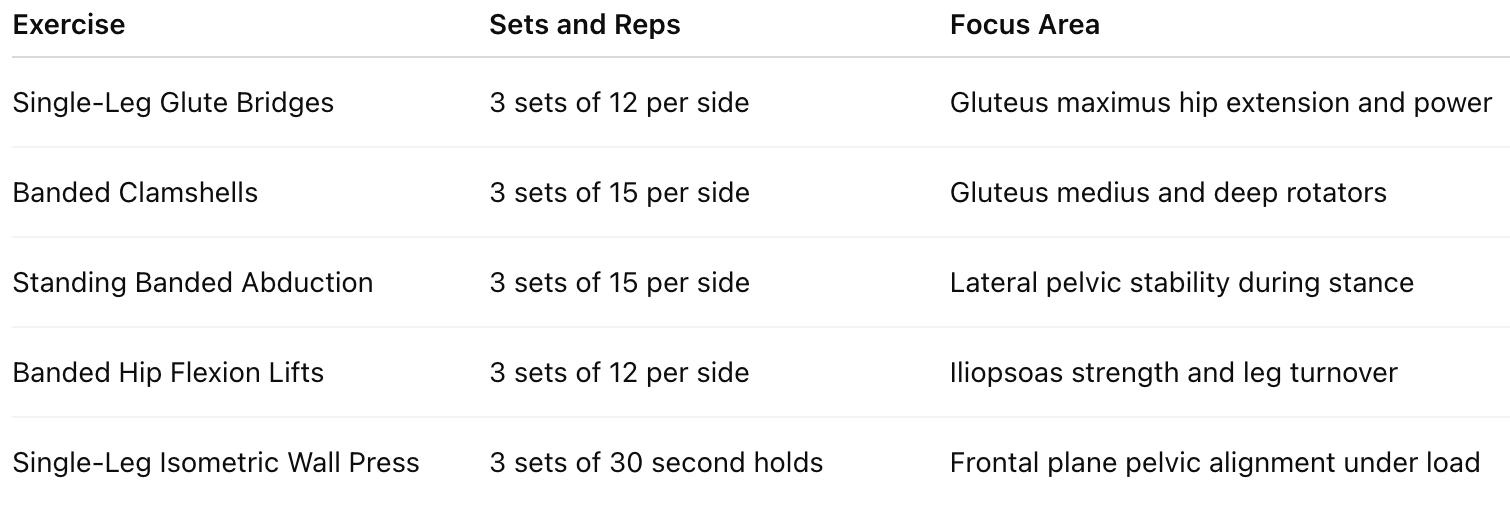
The At-Home Hip Resilience Routine
This structural routine can be executed seamlessly at home with minimal equipment to fortify your pelvis against running fatigue.
Conclusion
The forces transmitted through the lower extremities require a secure anchoring system at the pelvis. Mileage alone will not remedy imbalances. Incorporating a hip strengthening protocol into your regular training routine safeguards joints, ensures linear knee tracking, and unlocks a more efficient running stride.
Whether you're training for your first 5K, preparing for a half marathon, or simply looking to stay injury-free, dedicating just a few minutes each week to hip conditioning can significantly improve both performance and longevity. Strong, stable hips create a stronger foundation for every mile ahead.
.jpg)

.jpg)