
.jpg)
The Hydration Paradox
Do you know how to hydrate?
Many active people are chasing the wrong target. Hydration isn’t always about drinking more, but about maintaining the right balance of fluid and electrolytes.
Let’s talk about the science, how to decide when added electrolytes might be appropriate, and practical tools you can apply today.
When you sweat, you lose more than fluid. Every drop of sweat carries sodium, potassium, chloride, and smaller amounts of magnesium and calcium. Replacing those losses with plain water alone, especially in very large volumes, dilutes your blood sodium concentration. The term for this is hyponatremia, and it’s more common than most people realize, especially when exercising in the heat, using sauna, while also eating a mostly whole-foods based diet (processed/packaged foods contain plenty of sodium!)
The goal isn’t maximum fluid intake, but euhydration: the state of being properly fluid- and electrolyte-balanced.
What you’re actually losing when you sweat
Sweat composition varies significantly between individuals, but the main electrolytes lost are:
- Sodium and chloride - the primary losses; responsible for most electrolyte-related symptoms
- Potassium - critical for muscle contraction, heart rhythm, and nerve signaling
- Magnesium - often overlooked; implicated in muscle cramps, sleep quality, and post-exercise recovery
- Calcium - lost in smaller amounts; relevant in high-volume endurance contexts
Most hydration products focus mostly on sodium. That’s not completely wrong, as sodium is lost in the greatest concentrations, but if you’re experiencing persistent cramps, poor sleep, or sluggish recovery despite adequate sodium intake, magnesium deserves attention as well.
Quick check
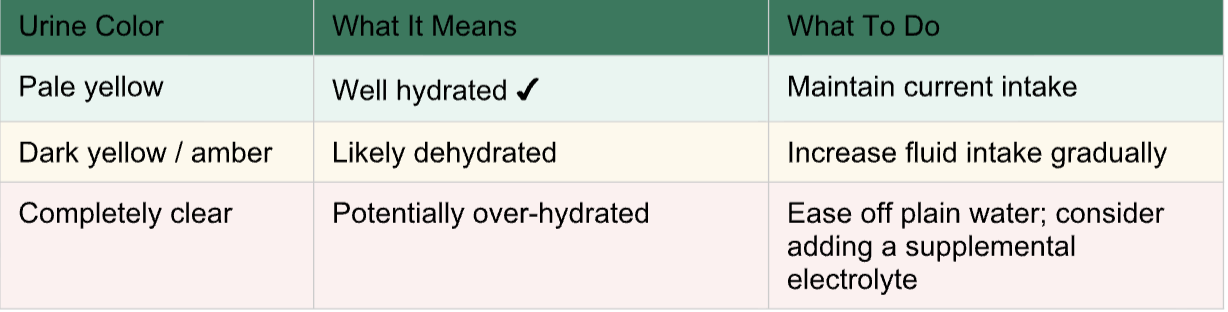
Urine color is an imperfect but practical daily hydration marker:
Timing matters
Chugging water 10 minutes before a sauna session or workout doesn’t meaningfully raise plasma volume. Your kidneys need about 2–4 hours to process a fluid load, adjust plasma osmolality, and establish a stable fluid state. Chugging right before activity results in a temporary plasma volume spike followed by a diuretic response (i.e. have to pee!), which is the opposite of what you want!
Practical rule: Build hydration into your day, not just your pre-workout routine. Consistent intake across the day is more effective than compensatory loading.
Pre-activity hydration targets (2-4 hours before activity)
Use body weight to calculate your pre-activity fluid target.
Examples by body weight:
- 130 lb (59 kg): ~12–14 oz, 2–4 hours out
- 160 lb (73 kg): ~14–17 oz, 2–4 hours out
- 190 lb (86 kg): ~17–20 oz, 2–4 hours out
Do you need electrolytes?
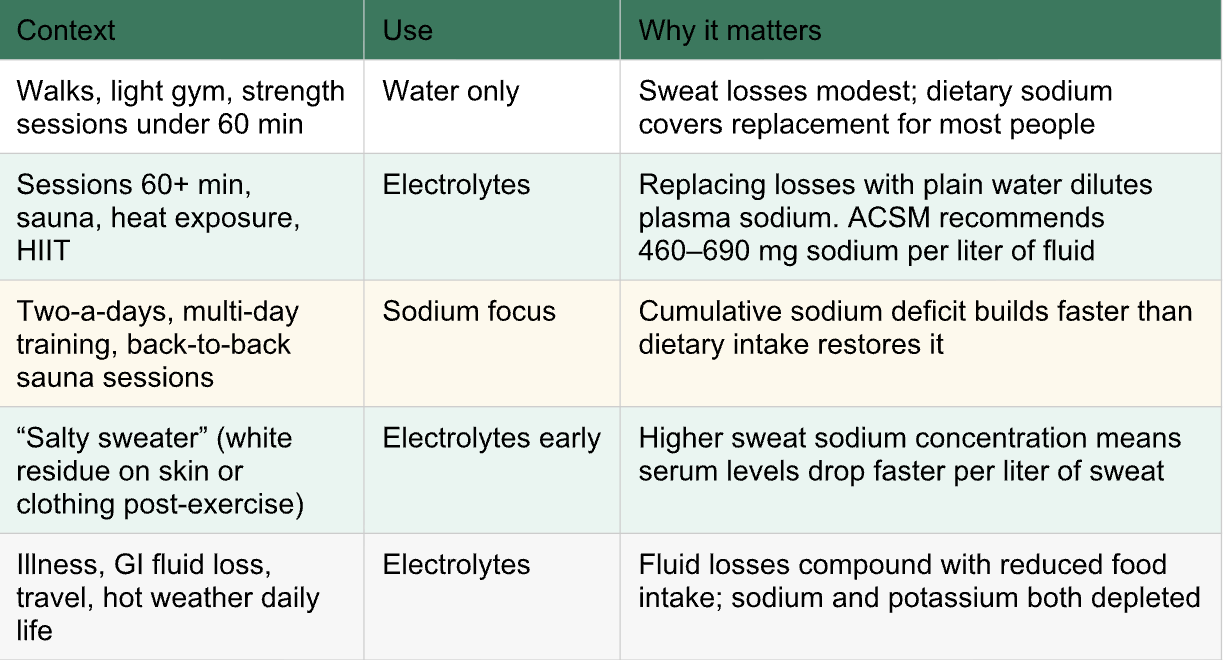
The answer depends on session duration, sweat volume, and individual factors. Here’s the framework:
Heat acclimatization caveat
With 10 days of repeated heat exposure (consistent sauna use or outdoor training in heat) sweat sodium concentration drops to approximately 60% of baseline. Your body becomes more efficient at conserving sodium!
If you’ve recently started a new heat protocol and you’re experiencing more cramps or fatigue than expected, inadequate sodium replacement during the transition period is often the first variable to address.
What are the signs that you may need electrolytes?
These are signals of electrolyte depletion, not just dehydration. Drinking more water in response to any of these will either do nothing or make it worse:
SymptomWhat it’s telling youGeneralized muscle crampsDiffuse heat cramps respond specifically to oral salt. If cramps ease within 20–30 min of a salty drink or food, sodium was the issue. Magnesium is also often a culprit.Headache despite drinking enough waterIf you’re well-hydrated by urine color but still getting post-sauna or post-exercise headaches, sodium depletion is more likely than dehydration.Brain fog without elevated temperatureMental status changes in the absence of high core temperature should raise concern for hyponatremia.Dizziness when standing upOrthostatic hypotension from combined dehydration and vasodilation. Accounts for ~30% of sauna-related injuries.Persistent fatigue during long sessionsWhen sodium and potassium fall, muscle function degrades before you feel thirsty. Fatigue that sets in mid-session despite adequate hydration is often electrolyte-driven.
Practical hydration protocol
Before activity
- Hydrate consistently throughout the day. A useful starting point: half your body weight (in lbs) in ounces daily. 150 lb person → 75 oz/day as a baseline.
- Use the pre-activity targets above (5–7 mL/kg, 2–4 hours out) scaled to your weight.
- Don’t rely on compensatory loading. Chugging water right before you start doesn’t work as the kidneys will excrete most of it before it’s useful.
During activity
- Sip consistently rather than bolusing. Large volumes at once can slow gastric emptying and blunt absorption.
- Calibrate to your sweat rate. Weigh yourself before and after a session twice. Each 1 kg (2.2 lb) of body mass lost ≈ 1 liter of fluid. Use that number to set your intake target.
- Add electrolytes at the 60-minute mark or earlier if you’re a salty sweater or training in high heat.
- Drink to thirst as your primary signal.
After activity
- Replace 125–150% of fluid lost, spread over 2–4 hours. Your body continues losing fluid through sweat, respiration, and urine after you stop, which is why over-replacing slightly is appropriate.
- If you are a “salty sweater”, this is prime time for electrolyte repletion.
- Consider potassium-rich foods in recovery. Avocado, banana, potatoes, and coconut water help restore what sweat depletes beyond sodium.
What to avoid
- High-sugar sports drinks for short sessions. Sugar slows gastric emptying and is unnecessary for workouts under 60–75 minutes.
- Drinking well beyond thirst in the belief that “more is better.” Thirst is a reasonably accurate real-time signal.
- Relying on caffeinated beverages as primary hydration.
The big picture
If you take nothing else from this guide:
- Start hydrating hours before activity, not minutes.
- Scale fluid targets to your body weight, not a fixed number.
- Add sodium after activity when sessions exceed 60 minutes.
- Drink to thirst.
- If symptoms persist despite adequate fluid intake, electrolytes (not more water) are likely the gap.
- Replace 125–150% of fluid lost post-activity, with sodium, over 2–4 hours.
References
Sawka MN, et al. ACSM Position Stand: Exercise and Fluid Replacement. Medicine & Science in Sports & Exercise. 2007.
Thomas DT, et al. Nutrition and Athletic Performance. Journal of the Academy of Nutrition and Dietetics. 2016.
Racinais S, et al. Consensus Recommendations on Training and Competing in the Heat. Scandinavian Journal of Medicine & Science in Sports. 2015.
Podstawski R, et al. Sauna-Induced Body Mass Loss. BioMed Research International. 2018.
Gauer RL, McNutt R, Bryan K. Heat-Related Illnesses. American Family Physician. 2026.
Eifling KP, et al. WMS Clinical Practice Guidelines for Heat Illness: 2024 Update. Wilderness & Environmental Medicine. 2024.
McCubbin AJ. Exertional Heat Stress and Sodium Balance. Autonomic Neuroscience: Basic & Clinical. 2021.
.jpg)

.jpg)