
.jpg)
Fast-forward to your kids' weddings or the birth of your future grandkids. Which matters more to you?
A) Having a perfectly shredded physique
B) Having a sharp, present mind to actually take in the memory
When you picture yourself in your 60s and 70s, what is your top priority?
A) Fitting into your college jeans
B) Remembering the names and faces of your family and closest friends
If you could guarantee one outcome from your health routine right now, what would it be?
A) Being 5 pounds lighter by next month
B) Gaining 5 extra years of independent living without relying on your adult children for basic care
While these questions might feel a bit extreme, the point is simple: when we strip away the noise, our deepest health goals are rarely about vanity. They are about time, presence, and independence.
Despite knowing what truly matters, the fitness industry constantly conditions us to focus solely on the immediate, observable present: weight loss, clothing sizes, and physique goals.
We try to eat more whole foods just to see a lower number on the scale. We sacrifice precious sleep to squeeze in miles on the treadmill, hoping to look better in summer clothes. We choke down expensive greens powders just to fix bloating.
But as busy parents and adults, your time and energy are already stretched to the limit. If you don't see immediate, observable progress—if the scale stalls, or your measurements don't budge—it is incredibly easy to get discouraged. You start to wonder: Why am I turning down convenience foods? Why am I forcing myself to exercise when it just feels like one more heavy chore on my never-ending to-do list?
If you've ever felt like your healthy habits are more of a burden than a benefit, it's time to shift your perspective to the ultimate return on investment: protecting your brain.
As parents, you plan for your family's future every day—saving for college, managing mortgages, and budgeting. But we need to look at the health data for your future, too:
- 57 Million: People currently living with dementia worldwide.
- 153 Million: The projected number of people living with dementia by 2050.
- 1 in 3 Adults: The number of seniors who will die with Alzheimer's or another form of dementia.
Statistically, cognitive decline is one of the greatest risks we face as we age. It impacts not just us, but the children who will eventually become our caregivers.
If this scares you a little, don't worry because you have the control!
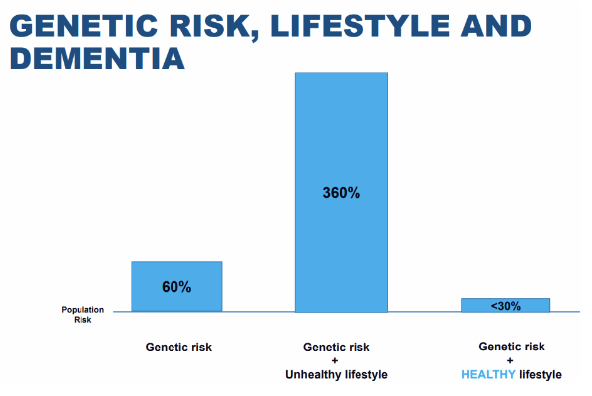
While genetics certainly play a baseline role in your cognitive risk, they are not your destiny.
The data shows that even for those with an increased genetic risk, lifestyle choices are the ultimate differentiator. Choosing unhealthy behaviors can skyrocket your risk of dementia by up to 300%. Conversely, consistently choosing healthy behaviors can slash that risk by roughly 30%.
The next time you feel frustrated because the scale isn't moving fast enough, remember this: every workout you finish, every whole-food meal you choose, and every extra hour of quality sleep you get isn't just about your waistline. It is a direct investment in your ability to stay sharp, stay independent, and stay fully present for your family for decades to come.
Moreover, with each added health behavior (e.g., healthy nutrition, better sleep, lower stress, more activity, etc.) individuals can potentially lower risk of Alzheimer's by upwards of 60% (3).

So, when you're juggling kids and chaos, you don't need perfection—just a shift in focus.
1. Prioritize Food Quality Over Calories
The Science
Following a MIND diet (berries, leafy greens, whole grains, nuts) can slash your Alzheimer's risk by 53%. Whole grains alone can lower dementia risk by 34%.
The Parent Reality
Skip the complicated meal prep. Just sneak simple wins into your family's routine—throw spinach into morning eggs, swap to whole-grain bread, or snack on berries while packing school lunches.
2. Focus on Movement Over "Workouts"
The Science
A study of over 430,000 people found that physical activity directly impacts brain volume. Active bodies mean bigger, healthier brains, while prolonged sitting sharply increases dementia risk.
The Parent Reality
If you can't get to the gym, battle sedentary time at home. Move wherever you can: take a family walk after dinner, pace during work calls, or do a quick 10-minute stretch on the floor while the kids watch TV.
3. Hit the 7-Hour Sleep "Sweet Spot"
The Science
Research shows 7 hours of sleep is the absolute optimal amount for cognitive health. Both getting too little sleep and oversleeping create a "U-shaped" risk curve for cognitive decline.
The Parent Reality
Consider this permission to stop stressing about not getting a perfect 8-9 hours. Avoid late-night scrolling and aim for the 7-hour "Goldilocks" target—just right for a parent's brain.
The Big Picture: Your Future Self Will Thank You
If you've read this far, all of this might just sound like a long-winded way of saying: eat your veggies, move your body, and get some sleep. You already know that.
But here is the real takeaway: these habits are incredibly easy to maintain when the scale is dropping, your clothes are fitting better, and you feel great. They are incredibly hard to maintain when you are exhausted, stressed, and seeing zero visual progress in the mirror.
As a busy parent, it is easy to look at a stalled scale and think, "Why am I even bothering?"
When those thoughts creep in, remember this: your brain is keeping score, even when your mirror isn't. Every single healthy choice you make is a deposit into your future cognitive bank account. You are actively protecting your memory, your sharpness, and your independence.
Stay the course. Keep making the healthier choice, even when it feels like it doesn't matter in the mirror. Your future self—and your kids—will thank you for it.
References
- Alzheimer's Association. What is Dementia? Available at: www.alz.org/alzheimers-dementia/what-is-dementia. Accessed November 21, 2024.
- Lourida, I., Hannon, E., Littlejohns, T. J., Langa, K. M., Hyppönen, E., Kuźma, E., & Llewellyn, D. J. (2019). Association of lifestyle and genetic risk with incidence of dementia. JAMA, 322(5), 430-437.
- Dhana, K., Evans, D. A., Rajan, K. B., Bennett, D. A., & Morris, M. C. (2020). Healthy lifestyle and the risk of Alzheimer dementia: Findings from 2 longitudinal studies. Neurology, 95(4), e374-e383.
- Morris, M. C., Tangney, C. C., Wang, Y., Sacks, F. M., Bennett, D. A., & Aggarwal, N. T. (2015). MIND diet associated with reduced incidence of Alzheimer's disease. Alzheimer's & Dementia, 11(9), 1007-1014.
- Wang, K., Tang, W., Hao, X., & Liu, H. (2023). High consumption of whole grain foods decreases the risk of dementia and Alzheimer's disease: Framingham Offspring Cohort. Psychiatry and Clinical Neurosciences, 77(3), 141-148.
- Huang, S. Y., Li, Y. Z., Zhang, Y. R., Huang, Y. Y., Wu, B. S., Zhang, W., ... & Yu, J. T. (2022). Sleep, physical activity, sedentary behavior, and risk of incident dementia: a prospective cohort study of 431,924 UK Biobank participants. Molecular Psychiatry, 27(10), 4343-4354.
.jpg)
.jpg)
.jpg)